A Content Analysis of YouTube Videos on Facial Palsy in South Korea
한국에서 안면신경마비를 다룬 유튜브 영상의 콘텐츠 분석
Article information

Abstract
Background and Objectives
YouTube has become a major source of health information, raising concerns regarding the accuracy of medical content. Facial nerve paralysis is a clinically significant condition with substantial functional, social, emotional, and economic impact. However, only limited studies have evaluated the quality of YouTube videos addressing facial palsy. This study aimed to review video content and assess the quality of information related to facial palsy on YouTube.
Subjects and Method
A YouTube search was performed using five Korean keywords: “안면신경마비,” “벨마비,” “람세이헌트,” “얼굴마비,” and “구안와사.” The top 100 Korean-language videos were screened using a newly created account. Videos unrelated to facial palsy were excluded. Content creators were categorized by professional background. Video quality was assessed using the Patient Education Materials Assessment Tool for Audiovisual Materials and a modified DISCERN score.
Results
Among the 100 included videos, 9 were produced by otolaryngologists, 44 by traditional Korean medicine doctors, 27 by other medical professionals, and 20 by lay persons. Bell’s palsy was the most commonly discussed condition, whereas Ramsay Hunt syndrome, central facial palsy, and traumatic facial paralysis were less frequently addressed. Otolaryngologists’ videos covered verified treatments such as corticosteroids, antiviral drugs, and protective agents for the eyes. Otolaryngologists’ videos showed significantly higher understandability and quality of information compared to others.
Conclusion
YouTube videos on facial palsy frequently contain low-quality or unverified information, which may negatively influence patients. The findings in this study highlight the importance of specialist involvement in providing accurate and reliable medical information.
Introduction
Facial nerve paralysis affects the muscles of facial expression and results in asymmetric facial movement, articulation difficulties, impaired mastication, and inadequate ocular protection, substantially reducing patients’ quality of life. In particular, social withdrawal and emotional stress due to changes in appearance can impose psychological and economic burdens on patients [1,2]. Facial nerve paralysis can occur due to various causes, including Bell’s palsy (idiopathic facial nerve paralysis), Ramsay Hunt syndrome, traumatic facial nerve paralysis, and central facial nerve paralysis, and treatment strategies and prognosis vary markedly depending on the cause [3-5]. Therefore, accurate diagnosis and evidence-based treatment are essential for patient management.
Along with its clinical importance, Bell’s palsy, which is the most common cause of peripheral facial nerve paralysis, is a common neurological condition, with an annual incidence ranging from approximately 11.5 to 53.3 per 100000 population [6-9]. Accordingly, public interest in the causes, treatment, and prognosis of facial nerve paralysis, and the demand for medical information, continue to increase.
With the rapid development of the internet and social media in recent years, patients and the general public can easily access medical information not only through consultations with healthcare professionals and printed media, but also through online platforms [10]. YouTube has become a major means of obtaining health information because it can provide audiovisual information simultaneously, and its influence on patient education is also gradually expanding. In the 2018 Health Information National Trends Survey, approximately 35% of U.S. adults were reported to have watched health-related videos on YouTube during the past 12 months [11], and in Korea as well, many users tend to search for information on disease causes, treatment methods, and prognosis through online videos [12]. However, YouTube is an open platform where anyone can create and upload content, and because most videos are provided without review, there is considerable variation in the accuracy and reliability of information depending on the content creator [13].
Korea has a distinct healthcare context compared with many other countries. Traditional Korean medicine doctors are licensed healthcare providers who can independently diagnose and treat patients. Under this healthcare system, various therapeutic approaches such as traditional Korean medicine treatment, acupuncture, and herbal medicine are presented to patients; however, concerns have been raised that some interventions lack robust evidence-based validation.
In the field of otorhinolaryngology, studies have already evaluated the quality of YouTube medical information on various topics such as tinnitus, thyroid cancer, and septal surgery, and many videos have been noted to introduce treatments that lack evidence or are unverified [14-16]. A previous study analyzing YouTube content on tinnitus in Korea reported that videos produced by otolaryngologists had significantly higher reliability and understandability than those produced by other creators, and that traditional Korean medicine treatment and non-scientific approaches were frequently introduced [14]. These findings suggest that similar problems may exist in facial nerve paralysis, a condition in which the timing of diagnosis and treatment has an important impact on prognosis.
Nevertheless, to date, studies that systematically analyze the content and quality of YouTube videos on facial nerve paralysis posted on Korean YouTube are very limited. In particular, evaluations have been insufficient regarding differences in information according to the creator’s expertise, how closely treatment content aligns with actual clinical practice guidelines, and understandability and information reliability as patient education materials. This information gap may increase the risk that patients are exposed to inaccurate information, miss the appropriate treatment window, or rely on unverified treatments.
Accordingly, this study aims to systematically analyze facial nerve paralysis related videos provided on Korean YouTube and to evaluate the characteristics of content creators, content composition, clinical accuracy, and quality as educational materials. Through this, we aim to identify the current status of facial nerve paralysis information provided in the online environment and to present foundational data for enabling specialist healthcare professionals to deliver reliable medical information effectively in the future.
Subjects and Methods
This cross-sectional study evaluated the content and quality of information in facial nerve paralysis related videos posted on Korean YouTube. Video searches were performed on September 1, 2023, on the YouTube platform (www.youtube.com). To reflect terminology commonly used by Korean patients, “안면신경마비(facial nerve paralysis),” “벨마비(Bell’s palsy),” “람세이헌트(Ramsay Hunt syndrome),” “얼굴마비(facial palsy),” and “구안와사(traditional term for facial palsy)” were used as search keywords. For each keyword, the top 100 videos by view count were collected, and to minimize personalization bias from the recommendation algorithm, searches were performed in the same environment using a newly created account with no viewing history or subscriptions.
Among the collected videos, those produced in Korean and focusing primarily on causes, symptoms, diagnosis, treatment, or prognosis of facial nerve paralysis were included for analysis. Videos were included only when the main topic was directly related to the condition, rather than cases where facial nerve paralysis was merely mentioned. In contrast, videos focusing on conditions with different pathophysiology from facial nerve paralysis such as facial spasm or hemifacial spasm, non-medical context content such as animal paralysis or accident videos, and videos related to dental care or cosmetic procedures were excluded.
For each video, metadata including title, channel name, video length, view count, and numbers of likes and dislikes were collected. Content creators were classified as institution, media, professional, or other, and for videos produced by professionals, creators were further subdivided into otolaryngologists, neurologists or neurosurgeons, traditional Korean medicine doctors, physicians from other specialties, nurses, and others. Whether the video had received official verification as a certified healthcare service provider was also investigated.
In the content analysis, evaluation focused on whether key causes and diagnosis, symptoms, and treatment methods of facial nerve paralysis were included. The presence of major causes such as central facial nerve paralysis, Bell’s palsy, Ramsay Hunt syndrome, and traumatic facial nerve paralysis were assessed. For symptoms, it was analyzed whether representative symptoms of peripheral facial nerve paralysis such as decreased forehead wrinkling, difficulty closing the eye, mouth deviation, abnormal lacrimation, taste disturbance, and drooling were included, along with symptoms related to Ramsay Hunt syndrome and central lesions.
To evaluate the validity of treatment and information included in each video, the Bell’s palsy clinical practice guideline (2013) presented by the American Academy of Otolaryngology-Head and Neck Surgery (AAO-HNS) and the facial nerve paralysis related chapters (Chapters 55-57) in the second edition of the Korean Society of Otorhinolaryngology textbook revised in 2018 were used as reference criteria [17,18]. In addition, the purpose of each video was classified as patient education, personal or institutional promotion, sharing personal experiences, selling related products, or other, and analyzed.
Understandability and actionability were assessed using the Patient Education Materials Assessment Tool for Audiovisual Materials (PEMAT-A/V). PEMAT-A/V is a tool developed by the U.S. Agency for Healthcare Research and Quality and is widely used to evaluate the health literacy level of patient education materials [19]. This tool consists of 17 understandability items and 4 actionability items, and each item was rated as “agree (1 point),” “disagree (0 point),” or “not applicable” (Table 1). For each subdomain, the score was calculated as a percentage by dividing the obtained score by the maximum possible score and multiplying by 100. Higher scores were interpreted as higher understandability and actionability, and scores below 70% indicate low understandability or actionability of the evaluated material.
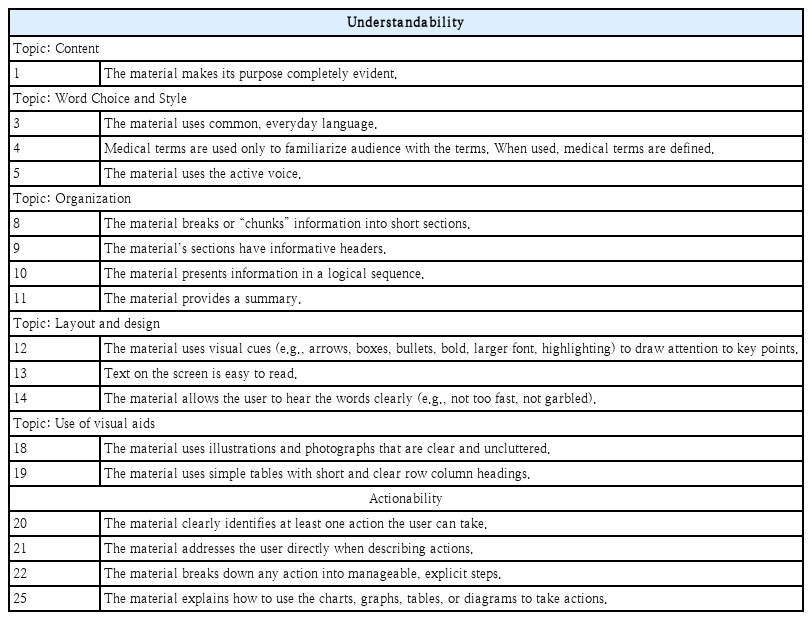
Patients Education Materials Assessment Tool for Audiovisual Materials score for understandability and actionability
Reliability and quality of information were assessed using the modified DISCERN score. This metric has been used in previous studies to evaluate the reliability and quality of information [14,15]. DISCERN is a standardized tool for assessing the quality of health information, and the modified DISCERN score consists of five items, including clarity, reliability, balance, whether references are provided, and whether uncertainty is mentioned. Each item was scored as 1 for “yes” and 0 for “no,” with a total score ranging from 0 to 5 (Table 2). Higher scores were considered to indicate better reliability and quality of information.
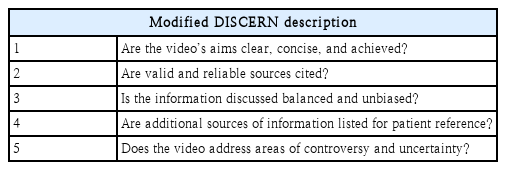
Modified DISCERN score for quality assessment
Continuous variables (view count, number of likes, video length, PEMAT-A/V score, and modified DISCERN score) were presented as mean and standard deviation, and categorical variables (creator type, video purpose, and whether causes, symptoms, and treatment content were mentioned) were presented as frequency and percentage. Differences in content characteristics and evaluation scores according to creator type were compared using the χ2 test or independent samples t-test. All statistical analyses were performed using IBM SPSS Statistics for Windows, version 27.0 (IBM Corp.), and p values below 0.05 were considered statistically significant. This study analyzed publicly accessible YouTube videos, did not include any personally identifiable information, and did not involve direct intervention with human subjects. The authors consulted their affiliated institution regarding the relevant procedures and did not separately apply for Institutional Review Board (IRB) approval.
Results
A total of 100 YouTube videos related to facial nerve paralysis were included in the final analysis. When creators were classified by occupational group, 9 videos were produced by otolaryngologists, and videos produced by traditional Korean medicine doctors accounted for the largest proportion at 44. Videos produced by other medical professionals were 27, and videos produced by lay persons were 20 (Table 3).
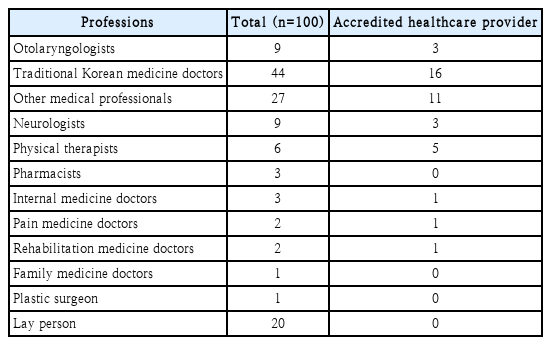
Profession of video creators for top 100 YouTube video clips on facial paralysis
Among the top 10 videos by view count, the video with the highest view count was produced by a family medicine doctor, with a total of 157226 views. None of the top 10 videos were produced by otolaryngologists. Three videos were produced by traditional Korean medicine doctors, five by lay persons, and one each by a family medicine doctor and a pain medicine doctor (Table 4). The mean number of subscribers across all videos was 300332.94±687595.20, the mean view count was 34951.89±30347.31, and the mean video length was 689.96±669.78 seconds (Table 5).
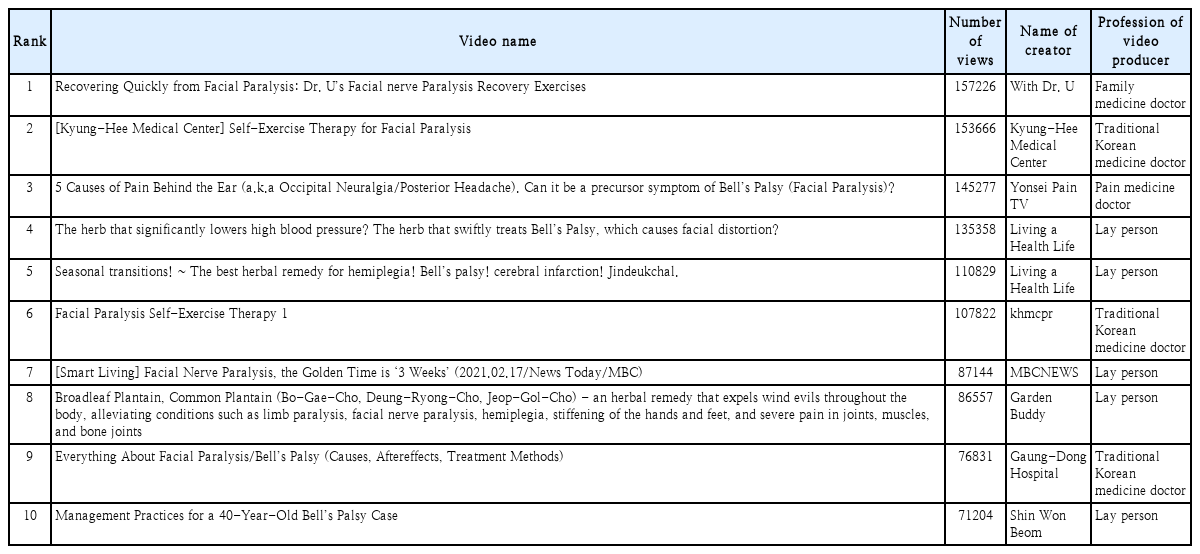
Top 10 YouTube video clips on facial paralysis
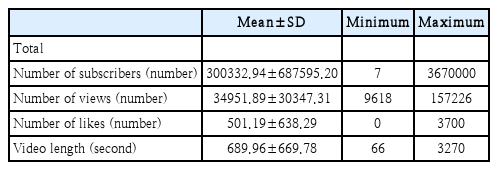
Statistics of meta-data in 100 most viewed video clips on facial paralysis
Table 6 analyzes the frequency of major topics mentioned in the top 100 videos by view count and compares topic inclusion rates between videos produced by otolaryngologists and those produced by non-specialists or lay persons. Bell’s palsy was mentioned in 53% of all videos, making it the most common diagnosis. In videos by otolaryngologists, Bell’s palsy was mentioned in 88.9%, which was significantly higher than in non-specialist videos (49.5%) (p=0.034), and Ramsay Hunt syndrome was also mentioned significantly more often in otolaryngologists’ videos at 66.7% compared with 23.1% in non-specialist videos (p=0.011). In symptom descriptions, taste disturbance (44.4% vs. 14.3%, p=0.043), tinnitus (44.4% vs. 5.5%, p=0.003), and dizziness (22.2% vs. 2.2%, p=0.040) were addressed significantly more frequently in otolaryngologists’ videos than in non-specialist videos.
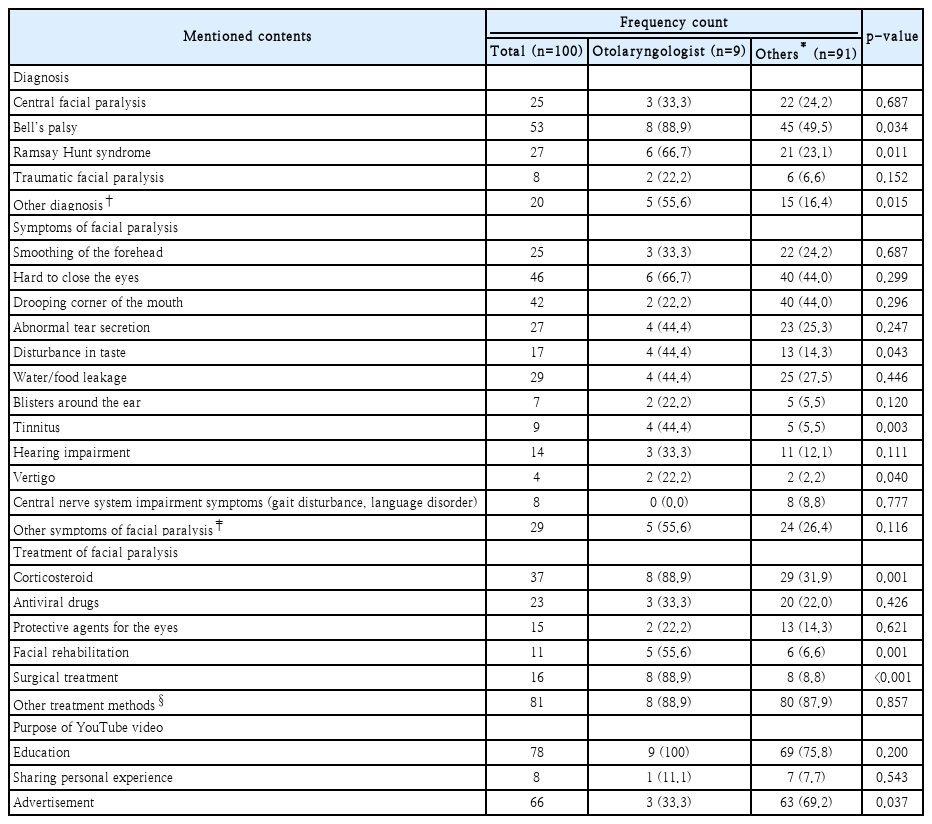
Contents analysis on 100 most viewed video clips on facial paralysis
In the treatment content analysis, steroid treatment was mentioned in 37% of all videos, and it was included in 88.9% of otolaryngologists’ videos, which was significantly higher than 31.9% in non-specialist videos (p=0.001). Facial rehabilitation treatment was also mentioned more frequently in otolaryngologists’ videos at 55.6% compared with 6.6% in non-specialist videos (p=0.001). Surgical treatment was also frequently mentioned in otolaryngologists’ videos (88.9 vs. 8.8%, p<0.001). In contrast, other treatment methods including traditional Korean medicine treatment, self-exercises, and folk remedies were mentioned in both otolaryngologists’ and non-specialist videos, with no statistically significant difference (p=0.857).
Regarding video purpose, educational purpose accounted for 78% of all videos, and all videos produced by otolaryngologists were for educational purposes (100%). In contrast, videos for advertising or promotion purposes were significantly higher in non-otolaryngologist creator videos at 69.2% compared with 33.3% in otolaryngologists’ videos (p=0.037).
In the video quality assessment, the overall mean PEMAT-A/V understandability score was 70.97±20.61, and otolaryngologists’ videos had a score of 85.15±10.15, which was significantly higher than 69.57±20.61 in non-specialist videos (p=0.022). The actionability score was also significantly higher in otolaryngologists’ videos at 92.59±14.69 compared with 64.80±36.84 in non-specialist videos (p=0.001). The modified DISCERN score was also significantly higher in otolaryngologists' videos at 4.56±0.53 compared with 1.74±1.31 in non-specialist videos (p=0.032) (Table 7).
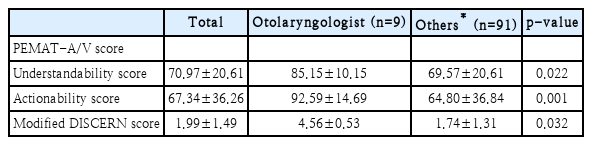
Assessment of understandability, actionability, and information quality for facial paralysis video clips using PEMAT-A/V and modified DISCERN score
Discussion
Although studies abroad have reported analyses of facial nerve paralysis related content using YouTube, no study has yet reported a systematic analysis of content composition and information quality of facial nerve paralysis related videos posted on Korean YouTube. This study systematically analyzed the content and quality of information in facial nerve paralysis related videos posted on Korean YouTube and demonstrated significant differences in the accuracy and educational value of medical information provided according to the creator’s professional expertise.
Among the 100 analyzed videos, only 9% were produced by otolaryngologists. However, these videos received significantly higher evaluations than those produced by non-specialists or lay persons in the understandability (PEMAT-A/V) score (85.15±10.15 vs. 69.57±20.61, p=0.022), the actionability score (92.59±14.69 vs. 64.80±36.84, p=0.001), and the modified DISCERN score assessing reliability and quality of information (4.56±0.53 vs. 1.74±1.31, p=0.032). In addition, many videos lacked evidence-based explanations or did not sufficiently explain the clinical characteristics of the disease.
These findings are consistent with the context of existing literature evaluating the quality of YouTube medical information. A systematic review of YouTube health information noted that while the platform greatly expanded accessibility for patient education, it also carries a risk of dissemination of biased or unverified information [20]. Subsequently, similar results have been repeatedly reported in studies on various otorhinolaryngologic diseases such as tinnitus, thyroid cancer, septal surgery, and cholesteatoma. These studies commonly reported that there was no significant correlation between view count or user engagement metrics and information quality, and that content produced by specialists or academic institutions showed relatively higher reliability [14-16,21]. By confirming that the same pattern is observed in facial nerve paralysis, this study reaffirms that the issue of information quality on YouTube is not limited to a specific disease.
Facial nerve paralysis is a condition in which limitations of the online medical information environment can have particularly important clinical consequences. In peripheral facial nerve paralysis, the timing of initial treatment after symptom onset plays a decisive role in prognosis, and delays in differential diagnosis such as Ramsay Hunt syndrome or central facial nerve paralysis can lead to reduced recovery rates or permanent functional disability. Nevertheless, many YouTube videos analyzed in this study were limited to explanations focused primarily on Bell’s palsy or did not sufficiently emphasize the importance of differential diagnosis and treatment timing. This suggests that if patients primarily search online information during the early stage of symptom onset, linkage to appropriate specialist care may be delayed.
Clear differences between creators were also observed in the treatment content analysis. In videos produced by otolaryngologists, evidence-based treatments consistent with clinical practice guidelines were addressed relatively thoroughly, including steroid treatment, selective use of antiviral agents, eye protection measures, and facial rehabilitation therapy. In contrast, in videos produced by non-specialists or lay persons, the frequency of mentioning these key treatment elements was low, and some videos emphasized unverified alternative therapies or self-treatment methods. This contrasts with existing clinical guidelines that recommend early steroid therapy in Bell’s palsy [17] and emphasize the importance of combined antiviral therapy in Ramsay Hunt syndrome [4,5]. These differences indicate that the professional expertise of the content creator has an important impact on the quality of treatment information conveyed in online medical information.
Another important finding identified in this study is that there is a consistent discrepancy between the level of information and popular exposure of videos. Many of the top viewed videos were composed around simple and intuitive messages rather than sufficiently explaining medical evidence, and this tendency has also been repeatedly reported in previous YouTube studies in the field of otorhinolaryngology. This suggests that exposure and spread of videos on YouTube tend to be driven more by viewer interest and interaction than by medical accuracy or reliability of information [22]. As a result, simple and intuitive content may spread more easily, and high view counts do not necessarily reflect information reliability. In such an environment, medically inaccurate information may also be widely exposed.
The evaluation results of this study using PEMAT-A/V and the modified DISCERN score in parallel provide important implications for interpreting these issues. PEMAT-A/V is a useful tool for evaluating the understandability and actionability of patient education materials, but high actionability does not necessarily indicate medical validity. In fact, in this study, some non-specialist videos had high actionability scores, but low information reliability. This suggests that “easy-to-follow actions” can provide patients with incorrect information, and emphasizes that in evaluating online medical information, understandability and actionability should be interpreted separately from information quality.
The context of the Korean healthcare environment is also an important factor in interpreting these results. In Korea, traditional Korean medicine doctors are institutionally recognized as medical professionals, and this creates an environment in which information about non-evidence-based treatments can spread relatively easily in online spaces. This characteristic can be regarded as a distinctive feature of domestic studies and an important consideration when comparing with international studies evaluating the quality of YouTube medical information. This study is meaningful in that it analyzed the characteristics of facial nerve paralysis related YouTube content within this Korean context.
This study has several limitations. As a cross-sectional study, it analyzed content only at a specific time point and therefore could not sufficiently reflect changes in video exposure over time or the influence of the recommendation algorithm. In addition, because only top viewed videos were analyzed, it is possible that high quality content with lower exposure was not included. Furthermore, because only Korean language videos were included, generalizability of the findings is limited. Nevertheless, this study systematically presented qualitative problems of medical information on facial nerve paralysis in the Korean YouTube environment and is meaningful in that it expanded the scope of existing otorhinolaryngology YouTube research to a clinically important disease.
In summary, this study shows that in diseases such as facial nerve paralysis where early diagnosis and treatment are important for prognosis, the quality of online medical information can have an important impact on patient decision-making. Videos produced by otolaryngologists were limited in number, but they were associated with higher in terms of information accuracy and educational value. In the future, specialist healthcare professionals should participate more actively in producing evidence-based content, and strategic approaches are needed to help patients select reliable medical information.
In conclusion, this study systematically evaluated the content and informational quality of YouTube videos on facial nerve paralysis in South Korea and found significant differences in the accuracy and educational value of medical information according to creators’ professional backgrounds. Although videos produced by otolaryngologists were limited in number, they more faithfully reflected evidence-based diagnosis and management and demonstrated higher understandability and information reliability. In contrast, many videos frequently introduced treatments supported by insufficient evidence, potentially leading to misconceptions among patients. These findings suggest that YouTube may substantially influence patients’ initial information-seeking and treatment decisions regarding facial nerve paralysis. Therefore, specialists should more actively provide accurate and reliable information on online platforms, and targeted efforts are needed to improve patients’ access to high-quality, evidence-based educational content.
Supplementary Materials
Korean translation of this article is available with the Online-only Data Supplement at https://doi.org/10.3342/kjorl-hns.2025.00598.
Notes
Acknowledgments
None
Author Contribution
Conceptualization: Jae Ho Chung, Hee Won Seo. Data curation: So Yeon Kim, Sang-Yoon Han. Formal analysis: Seong Man Hong, Hee Won Seo. Supervision: Jae Ho Chung, Seung Hwan Lee. Writing—original draft: Seong Man Hong, Jae Ho Chung. Writing—review & editing: Sang-Yoon Han, Hee Won Seo, Seung Hwan Lee.