The Sustainable Development Strategies for Otorhinolaryngology-Head and Neck Surgery: Focusing on Analysis of Member Perception Survey
이비인후-두경부외과의 지속가능한 발전 방안: 회원 인식 조사 분석을 중심으로
Article information

Abstract
The Otorhinolaryngology-Head and Neck Surgery (ORL-HNS) is responsible for essential medical care directly related to life maintenance and quality of life, including respiration, swallowing, communication, and head and neck tumors. However, due to recent structural transition projects for tertiary hospitals and the limitations of a rigid fee-for-service payment system, severe ORL-HNS diseases are administratively distorted as “mild cases.” This has led to a critical situation where the infrastructure within university hospitals is collapsing. To seek sustainable development plans for ORL-HNS, a survey was conducted from January 26 to 30, 2026. A quantitative evaluation alongside a qualitative analysis of subjective responses regarding job status were performed on 304 respondents. The results revealed severe clinical burnout; 67.4% of respondents complained of an excessive workload, and 61.2% expressed dissatisfaction with their income levels. The most overwhelming hindrances to ORL-HNS development were “low medical fee policies and government regulations” (88.8%) and “imbalances in relative value units and low medical fees” (90.1%). Furthermore, 86.5% perceived a serious crisis regarding the shortage of teaching faculty in training hospitals. The “Head and Neck” (63.8%) subdivision was identified as the most avoided field, raising concerns about future shortages of specialists and confirming a visible gap in life-saving essential care. Accordingly, this study explores specific alternatives to restore the fairness of cost-based compensation and lay the foundation for availability compensation, aiming to maintain the essential medical ecosystem and prevent the collapse of the ORL-HNS infrastructure.
Introduction
Amid population aging and a rapid rise in chronic diseases, the healthcare system in the Republic of Korea is confronting an accelerating crisis in fiscal sustainability, with National Health Insurance expenditures exceeding 106 trillion Korean won (KRW) in 2023 and projected to reach KRW 240 trillion by 2033 [1]. Despite this steep increase in National Health Insurance spending, the paradox of rising costs alongside stagnant outcomes has become increasingly evident, exemplified by a 30-day case fatality rate for acute myocardial infarction that exceeds the Organization for Economic Co-operation and Development (OECD) average [2]. In response, the government has pursued healthcare reform since 2024, centered on expanding a skilled healthcare workforce, rebuilding regional healthcare systems capable of providing comprehensive care locally, and establishing an equitable compensation system for essential healthcare services [3].
However, current government policy remains disproportionately focused on specific priorities, such as emergency care, pediatrics, obstetrics, and residency program fill rates. Consequently, conditions managed in otolaryngology-head and neck surgery—including airway obstruction, head and neck cancer, and severe hearing impairment—are mistakenly perceived as “low-acuity” or “nonessential,” resulting in a lower priority within healthcare policy [4]. This problem has become particularly apparent with the implementation of the tertiary general hospital restructuring support program. The current Korean Diagnosis-Related Group (KDRG) system places disproportionate weight on resource-use indicators, such as average length of stay and medical costs, rather than on surgical complexity or underlying medical conditions [4]. Consequently, only 26.1% of otolaryngology-head and neck surgery cases fall within the specialized disease group (Group A). As a result, the specialty is undergoing a gradual and largely unrecognized erosion of its institutional foundation, marked by reductions in clinical service volume and in the number of authorized full-time faculty positions at university hospitals, as well as a lower priority in the allocation of beds and operating rooms [4].
Based on a 2026 survey of members of the Korean Society of Otorhinolaryngology-Head and Neck Surgery, this study aims to empirically analyze physicians’ perceptions of their working environment and the policy-related factors contributing to the current crisis, explore approaches to designing a compensation system that addresses these structural limitations and propose a sustainable path forward for otolaryngology-head and neck surgery.
Subjects and Methods
This study was conducted to assess the current working conditions and perceptions of specialists and residents in otolaryngology-head and neck surgery amid rapid changes in healthcare policy and the healthcare delivery system. Its purpose was to provide empirical evidence to support the development of strategic responses by the Society and the formulation of proposals for reforming the reimbursement system.
The survey, titled “Member Opinion Survey on Strategies for the Advancement of Otolaryngology,” was conducted over a 5-day period from January 26 to January 30, 2026. The Google Forms survey link was distributed to all members via email using the addresses registered with the Society. Data were collected anonymously, and a total of 304 members completed the survey. Because this study involved secondary data analysis and did not constitute human subjects research, IRB review and informed consent were not required.
The survey comprised 25 items organized into the following five domains: 1) job satisfaction and working environment, 2) healthcare policy and future outlook, 3) workforce supply and demand and the crisis in residency training, 4) Society operations and development strategies, and 5) respondent characteristics. Frequency analysis was performed on the quantitative data.
In addition, a review of policy literature on the American Medical Association’s Current Procedural Terminology (CPT) coding system and the methodology used to calculate relative values under the Resource-Based Relative Value Scale (RBRVS) was conducted to establish a rationale for correcting distortions in the relative value scores for otolaryngologic procedures and revising surgical reimbursement rates to better reflect actual resource requirements.
Results
Job satisfaction and working environment
Overall, 42.1% of respondents reported being satisfied with their current job as an otolaryngologist (37.5% satisfied and 4.6% very satisfied), whereas 29.3% reported being neither satisfied nor dissatisfied and 28.6% were dissatisfied (20.4% dissatisfied and 8.2% very dissatisfied). When asked about the standing of otolaryngology relative to other specialties, 51.0% perceived it as low (28.3% somewhat low and 22.7% very low), suggesting that a substantial proportion of respondents viewed the specialty as disadvantaged. The factors most frequently cited as important in the choice of otolaryngology as a specialty were academic interest in the field (58.2%) and the ease of establishing a private practice and professional autonomy (51.0%).
Regarding workload in current clinical practice, 67.4% considered their workload excessive (45.4% somewhat excessive and 22.0% very excessive), indicating that respondents perceived a substantial workload burden. By contrast, 61.2% were dissatisfied with their current income level (35.9% dissatisfied and 25.3% very dissatisfied), suggesting that compensation was perceived as low relative to workload. In a multiple-response question on the greatest obstacles to the practice and development of otolaryngology, 88.8% of respondents selected “low reimbursement rates and tighter government regulation of non-covered services and private indemnity health insurance.” (Table 1)
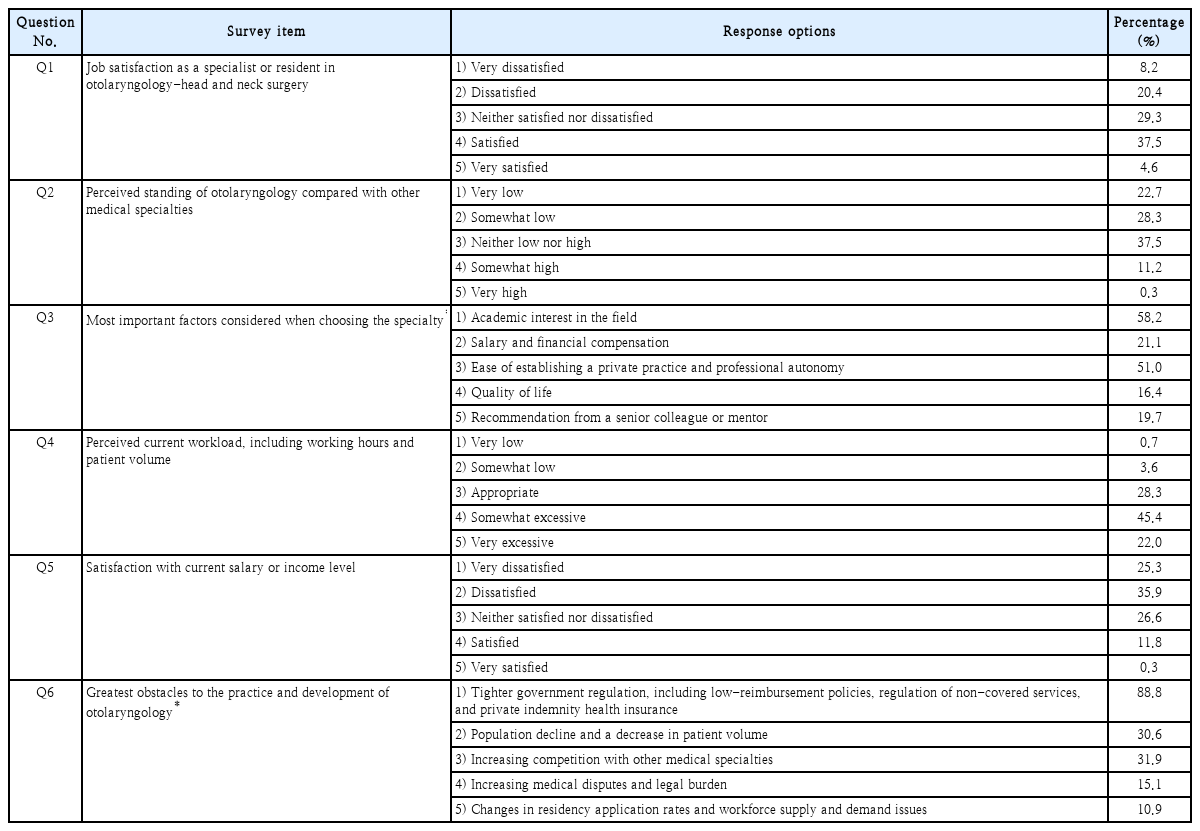
Job satisfaction and work environment survey (n=304)
Healthcare policy and future outlook
The environmental factor most frequently identified as threatening the standing of otolaryngology was likewise “imbalances in relative value scores and low reimbursement rates,” selected by 90.1% of respondents. Correspondingly, 94.7% identified “establishing more appropriate reimbursement rates and adjusting relative value scores” as the policy issue that the Society should address most urgently to protect physicians’ rights and interests.
Otology, including hearing rehabilitation and dizziness, was identified by 73.0% of respondents as the field expected to experience the greatest increase in demand. Meanwhile, 58.3% anticipated that the introduction of telemedicine and AI-based diagnostic technologies would have a negative effect on the private practice sector (37.2% somewhat negative and 21.1% very negative), reflecting concerns about misdiagnosis and the uneven distribution of patients resulting from the rapid adoption of these technologies (Table 2).
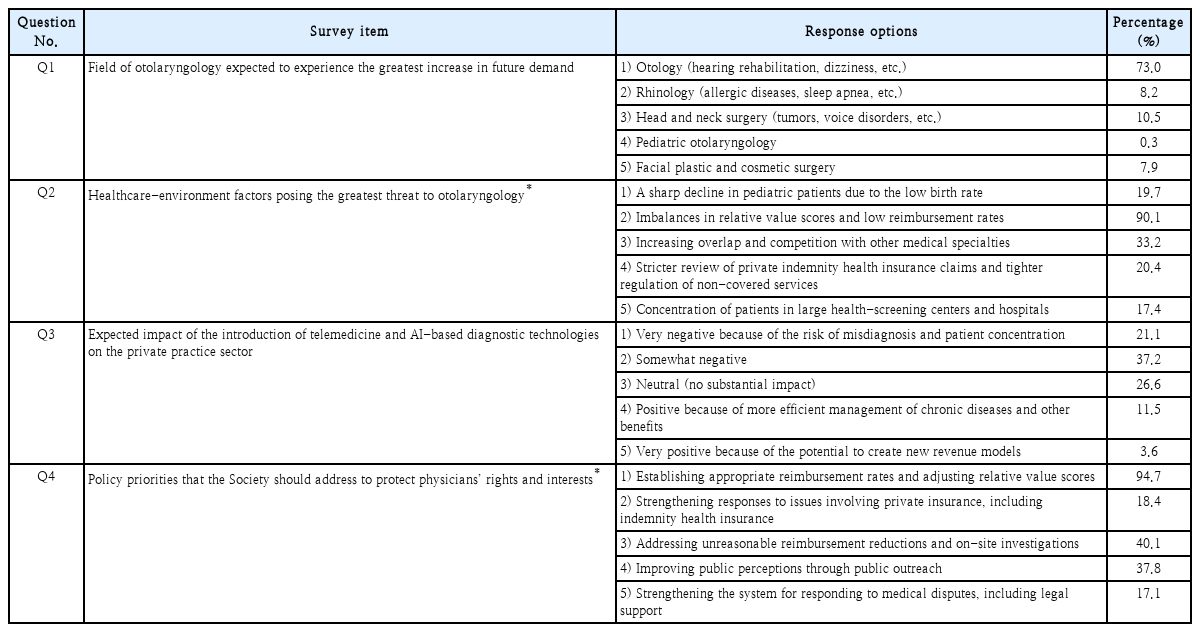
Healthcare policy and future prospects (n=304)
Workforce supply and demand and the crisis in residency training
Because its comparatively high residency application rate has been cited as grounds for excluding it from government support for essential healthcare, otolaryngology has also been disadvantaged under initiatives such as the tertiary general hospital restructuring support program. Members identified two emerging structural threats: persistent workforce imbalances caused by specialists leaving training hospitals for private practice (72.7%) and the diminished standing of the specialty within tertiary general hospitals along with reductions in allocated positions (60.5%).
A total of 63.8% identified head and neck surgery as the subspecialty expected to have the fewest newly trained specialists in the future. In addition, 86.5% considered the shortage of faculty members in otology, rhinology, and head and neck surgery at university hospitals to be serious (46.4% serious and 40.1% very serious). In a multiple-response question, the most frequently cited reason for not applying for faculty or fellow positions was the relatively low compensation compared with private practice (81.6%), followed by the demanding workload associated with duties such as on-call coverage and surgery (52.3%) and the excessive research and administrative burden at university hospitals (51.3%) (Table 3).
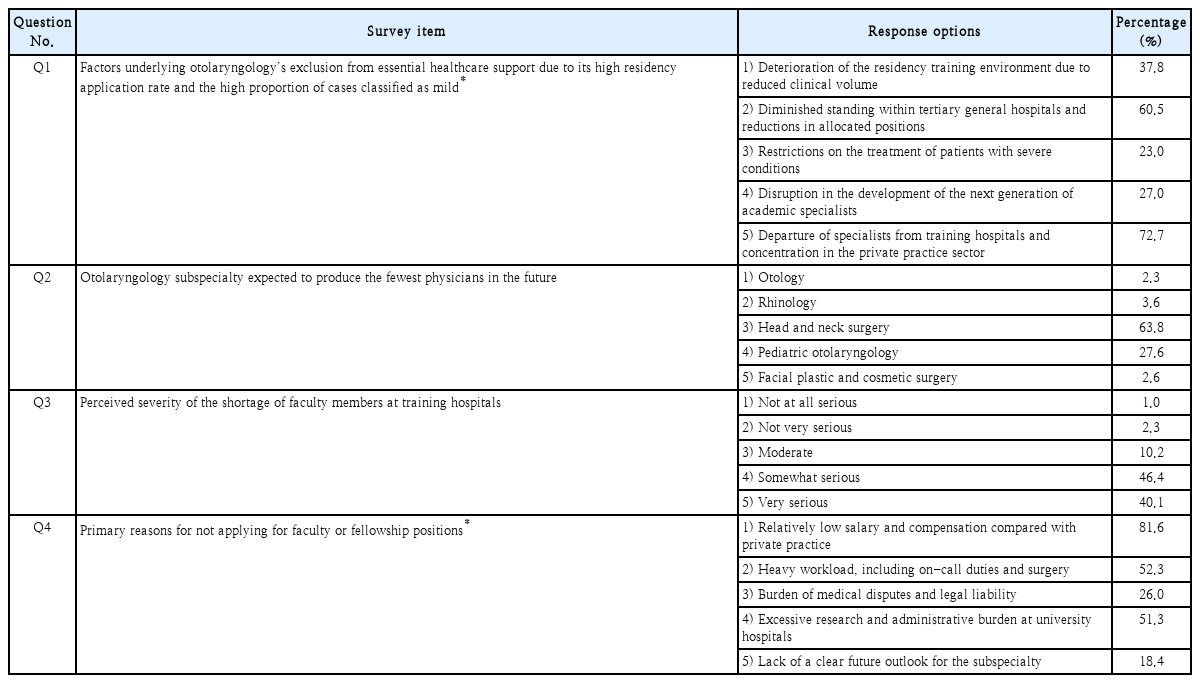
Human resources supply and training crisis (n=304)
Society operations and development strategies
The area most frequently selected for increased Society investment was strengthening government advocacy and reimbursement negotiation capacity (64.8%), followed by public outreach (43.8%). Regarding academic conference programs, demand was greater for policy discussions and symposia on institutional reform (63.2%) and for practical guidance on insurance claims and hospital management (51.6%) than for academic research content (45.1%). The most urgent priorities for the development of the Korean Journal of Otorhinolaryngology-Head and Neck Surgery were improving accessibility for members, including through the development of a mobile application (47.0%), and expanding the range of thematic articles and case reports (39.8%). In the free-text responses regarding committees that should be established or strengthened, the most frequent requests were for a Health Insurance Committee (71 respondents), a New Health Technology (AI) Committee (17 respondents), and a Reimbursement and Relative Value Committee (16 respondents) (Table 4).
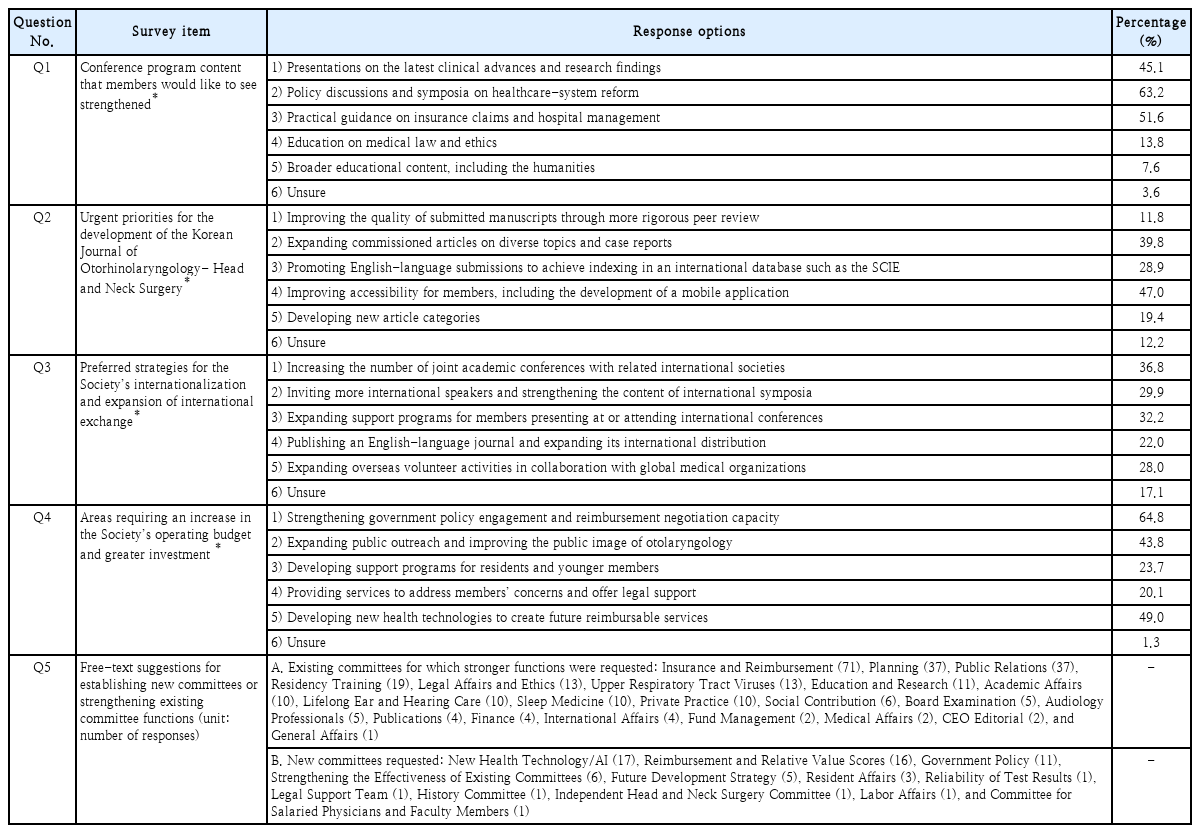
Management and development plan of the society (n=304)
Respondent characteristics
Among the 304 respondents, 76.3% were men (232 respondents) and 23.7% were women (72 respondents). By occupational category, private practitioners constituted the largest group at 42.8% (130 respondents), followed by faculty members at 29.3% (89 respondents), employed physicians at 10.9% (33 respondents), residents at 8.6% (26 respondents), military or public health physicians at 4.6% (14 respondents), and fellows at 3.9% (12 respondents). Respondents in their 50s constituted the largest age group at 32.9% (100 respondents), followed by those in their 40s at 29.9% (91 respondents) and those in their 30s at 23.4% (71 respondents) (Table 5).
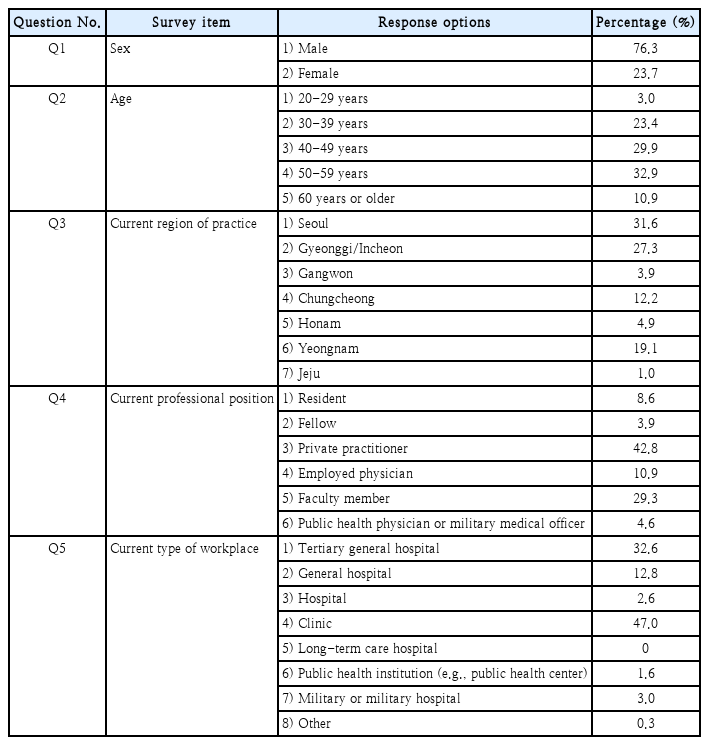
Respondent basic information (n=304)
Discussion
Analysis of the member perception survey findings
The findings of this perception survey quantitatively demonstrate that the current healthcare ecosystem of otolaryngology-head and neck surgery has reached a critical juncture. The demoralization observed in clinical practice and the warning signs of infrastructure collapse suggest that the problem constitutes a structural market failure arising from contradictions in the broader healthcare payment and reimbursement system, compounded by rapid policy changes, rather than shortcomings at individual medical institutions or among individual physicians.
Structural limitations of volume-based fee-for-service reimbursement and distortions in the compensation system
The heavy workload and sense of relative deprivation among otolaryngologists identified in this study stem from the chronically low reimbursement structure under the fee-for-service system that has long sustained the healthcare system in the Republic of Korea. In the survey, 67.4% of respondents reported that their current workload was excessive, and 61.2% expressed dissatisfaction with their current income. This combination of a heavy workload and inadequate compensation has contributed to the perception, reported by 51.0% of respondents, that otolaryngology holds a lower standing than other specialties, thereby reinforcing clinicians’ sense that their specialty is undervalued.
Private practices have also been largely excluded from alternative payment models introduced to complement the current reimbursement structure. Value-based payment mechanisms, which link compensation to the quality or value of care, account for only 1.4% of overall healthcare payments, and approximately 68.2% of this limited share is concentrated in tertiary general hospitals [5]. This distribution indicates that the characteristics of primary care, including a high proportion of brief outpatient visits and limited administrative resources, are not adequately recognized in value assessment systems. It thus reveals a structural limitation that reinforces the concentration of compensation in large hospitals and widens the divide between primary care and tertiary general hospitals.
In a fee-for-service environment in which cost recovery rates for basic consultation and procedure fees fall far below actual costs, primary care clinics that are also excluded from value-based reimbursement inevitably depend on maximizing service volume to remain financially viable. This structure forces physicians to see hundreds of patients per day and prevents patients from receiving in-depth care, thereby perpetuating a vicious cycle inherent in the current system. Accordingly, the findings that 88.8% of members identified low reimbursement rates and tighter government regulation of non-covered services and private indemnity health insurance as the greatest obstacle and that 90.1% identified imbalances in relative value scores and low reimbursement rates as the greatest threat can be interpreted as a call from clinicians for comprehensive reform of a distorted payment system that is excessively focused on service volume.
Rigidity of the healthcare system and delays in establishing reimbursement for new health technologies
The rigidity of government healthcare policy and payment-system governance is a major factor limiting the future sustainability of otolaryngology-head and neck surgery [4]. A fragmented landscape of approximately 49 payment-related pilot programs currently exists in the Republic of Korea, yet no systematic criteria or governance mechanisms exist for converting them into full-scale programs or terminating them. As a result, some programs have remained at the pilot stage for more than 10 years without progressing to full implementation, reflecting substantial institutional stagnation.
This bureaucratic stagnation directly conflicts with members’ calls for new revenue models and growth opportunities. In anticipation of an era of physician oversupply resulting from the rapid expansion of medical school admissions, members want otolaryngology to develop distinctive areas of expertise that are not easily replicated by other specialties. However, passive government administration and a rigid payment-system governance structure obstruct the introduction of new technologies and reimbursement mechanisms, effectively precluding innovative initiatives in clinical practice.
The finding that 49.0% of respondents selected “creating future reimbursement opportunities through the development of new health technologies” as a key area for increased Society investment reflects members’ expectation that the Society should take the lead in overcoming the stagnation of the healthcare payment system. To address this institutional rigidity, the Society should establish a research foundation for demonstrating the clinical effectiveness and cost-effectiveness of new health technologies and should focus its policy advocacy on reforming the inefficient structure centered on pilot programs.
Tertiary general hospital restructuring and the less visible erosion of the foundation of otolaryngology-head and neck surgery
Beginning in 2026, the government’s tertiary general hospital restructuring support program entailed an across-theboard reduction in the total number of general inpatient beds to 85% of the previous level [4]. Although the stated aim of the policy was to reorganize the healthcare system around patients with severe and emergency conditions, it effectively prioritized services, largely for administrative convenience, solely according to whether a condition was considered directly life-threatening.
The major procedures performed in otolaryngology-head and neck surgery constitute function-preserving essential care directly related to human dignity and quality of life, including the preservation of hearing, breathing, swallowing, and verbal communication. Nevertheless, these procedures are relatively undervalued because they are given lower priority than services for cardiovascular and cerebrovascular diseases or severe trauma under current policy criteria for clinical urgency. Consequently, they receive lower priority in the allocation of hospital resources, including scheduled operating room time, which limits timely surgery for patients with severe conditions. The resulting reduction in clinical volume then provides hospital administrators with a rationale for curtailing personnel and equipment support for otolaryngology-head and neck surgery.
These developments directly worsen the working conditions and professional standing of faculty members and even erode their pride as academics. Faculty shortages have recently become increasingly evident at training hospitals, consistent with the 86.5% of members who regarded the problem as serious. The resulting departure of faculty and deterioration of the training infrastructure are creating a structural crisis in the training system. Ultimately, tertiary general hospitals responsible for training future specialists and providing highly complex care, including head and neck cancer surgery and cochlear implantation, risk losing the physicians capable of performing these procedures.
Lack of additional compensation for specialties providing definitive emergency care and the risk of losing essential subspecialties
In the survey, 52.3% of respondents identified the demanding workload associated with excessive on-call duties and surgery as a fundamental reason for not applying for faculty or fellow positions. Head and neck surgery was also identified by 63.8% of respondents as the subspecialty expected to have the fewest newly trained specialists in the future.
As strongly emphasized in the free-text responses, deep neck infection is a common and severe emergency that can become rapidly fatal owing to airway obstruction. Nevertheless, reimbursement for this condition remains inadequate, and its severity continues to be underestimated. Otolaryngology-head and neck surgery has also been largely excluded from government support schemes for essential specialties and those at risk of workforce depletion, including residency training allowances and emergency department care allowances.
Faculty members who work more than 80 hours per week without appropriate compensation are losing confidence in their future prospects and leaving university hospitals, while applications to otolaryngology residency programs are also at risk of declining to critically low levels. The failure to compensate specialists who provide definitive emergency surgical care for weekend and nighttime standby duties constitutes a major gap in the reimbursement system. This lack of compensation is a key factor exacerbating gaps in the provision of essential healthcare.
Strategies for sustainable development
The crisis in otolaryngology-head and neck surgery identified in this survey extends beyond isolated imbalances in reimbursement. It suggests that the specialty has reached a structural inflection point at which its identity and role must be redefined amid broader changes in the healthcare environment, including declining birth rates, population aging, and the rapid emergence of AI technologies. Achieving sustainable development within this rapidly changing healthcare paradigm will require the coordinated implementation of multiple complementary strategies.
Proactive transition to a diversified payment portfolio
The Society’s strategy for establishing appropriate reimbursement levels and reforming the low-reimbursement structure cannot remain confined to conventional demands for across-the-board fee increases, as such an approach is unlikely to succeed. The government’s broader healthcare roadmap aims to reduce the share of the conventional fee-for-service system to 70%-75% by 2030 and to fully implement a diversified payment portfolio grounded in reliable cost analyses, including bundled payments, quality- and value-linked reimbursement, and person-centered payment [6].
The Society should therefore anticipate this policy shift and proactively design and propose value-based payment models suited to otolaryngology-head and neck surgery. Building on the global trend toward payment structures that promote collaboration among providers and population health management, the Society should lead the development of bundled payment models linked to quality-of-life outcomes across the life course for disease groups commonly managed in primary otolaryngology practice. These should include chronic rhinitis and allergic diseases, as well as hearing loss and auditory rehabilitation, dizziness, and sleep apnea-conditions of growing importance in a super-aged society.
Such a system would help practices move away from a structure in which survival depends on seeing large numbers of patients and relying on revenue from one-time consultation fees. Instead, it would support a stable private-practice environment in which physicians receive greater compensation for providing high-quality, in-depth care and continuous patient management. To achieve this transition, the Society should establish a dedicated committee for reimbursement and payment-system reform and engage in rigorous, evidence-based negotiations with the government.
Detailed classification of medical procedures and scientific measurement of workload and costs
Diagnosis and surgery in otolaryngology-head and neck surgery have evolved from predominantly direct-vision approaches to high-precision diagnosis and microsurgery using high-resolution endoscopes and surgical microscopes. However, the current Korean relative value score system does not adequately reflect these technological advances or the accompanying changes in required resources, including expensive equipment and specialized expertise, creating the paradox that technological progress can result in financial losses for hospitals [7]. By comparison, the United States uses CPT, a standardized system for classifying and coding medical services, together with the RBRVS to define individual services and systematically quantify the resources required for their provision. Correcting undervalued reimbursement rates and ensuring the sustainability of medical services therefore require the Korean system to benchmark the US CPT/RBRVS system in the following ways.
First, Korean reimbursement codes classify procedures such as endoscopic sinus surgery under a single comprehensive code without accounting for the number of sinuses opened or their anatomical complexity. As in the CPT system, these codes should be subdivided according to anatomical location, surgical approach, and procedural complexity, including simple procedures, complex procedures, and revision surgery.
Second, codes for diagnostic endoscopy should be clearly distinguished from those for therapeutic or surgical endoscopy in order to reflect differences in technical complexity. New add-on codes should be introduced, or existing codes should be further subdivided, according to whether laser or navigation systems are used.
Third, physician work must be urgently reassessed. This assessment should not be based solely on time but should also quantify mental effort and judgment, technical skill, physical effort, and stress. Invisible work, including equipment setup and preoperative CT-based anatomical mapping, should be quantified through time-and-motion studies and incorporated into reimbursement as a prerequisite for rationalizing payment levels.
Fourth, otolaryngology-head and neck surgery requires expensive equipment, including endoscopes, microscopes, and audiometric booths, resulting in substantial depreciation and maintenance costs. As in the United States, where these expenses are calculated as direct costs and incorporated into reimbursement, Korea should collect detailed data on the costs of consumables and equipment that are currently overlooked and use these data to establish realistic cost recovery rates.
Limitations of the patient classification system and reform of the specialized disease group framework
The current KDRG system has several limitations. First, its foundation lies in earlier research on bundled payment commissioned by the Health Insurance Review and Assessment Service.8) The system was originally developed as a healthcare reimbursement framework to separate physician costs from hospital costs and to classify hospital costs by disease, rather than to distinguish the clinical severity of individual conditions. Consequently, although conditions and procedures of widely varying severity are grouped within the same disease group, the KDRG system is broadly misused as an indicator of clinical severity.
Second, the government’s classification criteria rely on simple statistical measures of where a given condition is most frequently treated, rather than on the patient’s underlying conditions or surgical complexity. Even identical procedures, such as tonsillectomy or septal surgery, are categorized as general Group B or simple Group C cases regardless of the patient’s condition, merely because they are commonly performed in primary care clinics. Patients who cannot undergo surgery at primary care institutions because of serious underlying conditions, including cardiovascular disease, severe obesity, or severe sleep apnea, and who are therefore referred to tertiary institutions may still be uniformly assigned to the same low-severity groups. This produces the erroneous outcome of penalizing tertiary general hospitals for treating such patients. The current classification also fails to reflect the multimorbidity associated with population aging or the corresponding level of resource utilization.
Third, even when professional societies seek to separate high-complexity procedures into independent disease groups on the basis of patient age or surgical complexity, the current KDRG system restricts the creation of an independent disease group when there are fewer than 300 cases per year. Rare conditions such as congenital aural atresia and pediatric laryngeal stenosis, which are potentially fatal yet uncommon and difficult to treat, therefore fall into a classification blind spot in which they cannot be appropriately recognized as severe conditions.
Finally, cases in specialties such as otolaryngology, ophthalmology, orthopedic surgery, and plastic surgery are prone to being classified as low severity despite involving highly complex care. These specialties are consequently placed at a substantial disadvantage in tertiary general hospital evaluations, which ultimately contributes to the progressive erosion of these specialties.
To overcome these limitations, the KDRG system should introduce exception mechanisms or detailed classification codes that allow cases ordinarily assigned to Group B or C on the basis of diagnosis alone to be upgraded to Group A according to the patient’s underlying conditions, the anatomical location of the lesion, including the skull base or deep neck, the specialized equipment required, and the level of surgical expertise involved. Specialty-specific adjustment coefficients should also be introduced immediately into the evaluation of tertiary general hospitals. The characteristics of otolaryngology-head and neck surgery should be explicitly taken into account, including its predominantly outpatient-based practice structure and the unavoidable need to admit patients referred from primary care who fall within Groups B and C. Rather than uniformly imposing a hospital-wide target proportion for Group A cases, such as 70%, the evaluation system should substantially reduce penalties related to the proportion of low-severity cases or apply a separate evaluation pathway through flexible adjustment of performance indicators.
Establishing a special add-on for microsurgery adjacent to cranial nerves and the skull base
A primary reason that neurosurgical craniotomy receives high reimbursement is the risk of damage to brain tissue and neural structures. Mastoid surgery, ossicular reconstruction, and endoscopic skull base surgery in otology and rhinology are similarly high-risk procedures that involve drilling bone only a few millimeters from the facial, vestibulocochlear, and optic nerves and the meninges. In head and neck surgery, malignant tumor resection and neck dissection are also highly complex procedures performed while preserving major neurovascular structures, including the carotid artery, internal jugular vein, and hypoglossal and vagus nerves.
A new reimbursement mechanism should therefore explicitly designate procedures performed adjacent to cranial nerves or the skull base and provide a “high-risk microsurgery” addon equivalent to approximately 30%-50% of the base surgical fee. In neurosurgery, craniotomy receives a 50% increase in the anesthesia fee in recognition of its procedural complexity and duration. Cochlear implantation, vestibular schwannoma surgery, and head and neck reconstructive surgery are similarly complex microsurgical procedures that may require 5-10 hours or longer. The relevant reimbursement regulations should therefore be revised to establish designated codes for complex, prolonged microsurgical procedures in otolaryngology-head and neck surgery and include these procedures as exceptions to the current guideline limiting the 50% anesthesia fee add-on to craniotomy. This revision would allow these procedures to receive equivalent compensation.
Reframing the public outreach strategy
The distorted public and governmental perception that otolaryngology-head and neck surgery is merely a specialty that treats uncomplicated colds must be dispelled. Beyond treating common colds, the specialty provides care for life-threatening airway conditions, performs complex head and neck cancer surgery, and offers specialized care for hearing loss, dizziness, and thyroid disease. Its fundamental identity as an essential specialty providing critical and emergency care should therefore be communicated to the public on an ongoing basis. Improving public awareness and sustaining these outreach efforts are prerequisites for securing due recognition of the specialty’s expertise, fair compensation, and greater professional standing in government policy development and reimbursement negotiations.
Conclusion
Conducted during a period of major transformation in the healthcare system of the Republic of Korea, this survey of Society members empirically demonstrates that the challenges facing otolaryngology-head and neck surgery extend beyond fatigue in clinical practice to encompass structural contradictions and a crisis of sustainability. Constrained by the tertiary general hospital restructuring support program and an outdated fee-for-service framework, the essential healthcare infrastructure that safeguards patients’ ability to breathe and hear is undergoing structural erosion.
Paradoxically, however, this crisis also represents a decisive turning point at which otolaryngology-head and neck surgery must move beyond fragmented clinical practices, establish a new paradigm, and design a genuinely sustainable model of care. A critical window of opportunity to reverse the current trajectory remains. The Korean Society of Otorhinolaryngology-Head and Neck Surgery should bridge the divide between the private practice sector and training hospitals and stand united under the banner of “ENTians! As One.” The Society should proactively respond to the government’s broader roadmap for payment-system reform and maximize its capacity to negotiate with the government. Together, these efforts constitute an urgent mandate of our time.
Although implementing the multifaceted policy roadmap proposed in this study will not be straightforward, it may nevertheless serve as a compass for the society as it takes the lead in addressing unreasonable regulations. Through these efforts, otolaryngology-head and neck surgery may be duly recognized in healthcare policy for its value and expertise as an essential healthcare specialty and ultimately contribute to improving public health.
Supplementary Materials
Korean translation of this article is available with the Online-only Data Supplement at https://doi.org/10.3342/kjorl-hns.2026.00465.
Notes
Acknowledgments
I would like to express my deep gratitude to the 304 members of the Korean Society of Otorhinolaryngology-Head and Neck Surgery for taking the precious time to share their sincere opinions and voices in the field in this survey. Your earnest suggestions will be the strongest basis and milestone for the society to pursue negotiations and health care policies in the future.
Author Contribution
Conceptualization: Seog-Kyun Mun. Data curation: Kye-Hyun Kim. Formal analysis: Ji Min Yun. Investigation: Ji Min Yun. Methodology: Kye-Hyun Kim. Project administration: Heonjeong Oh. Resources: Dong Young Kahng. Software: Heonjeong Oh. Supervision: Seog-Kyun Mun. Validation: Dong Young Kahng. Visualization: Kye-Hyun Kim. Writing—original draft: Ji Min Yun. Writing—review & editing: Seog-Kyun Mun.